

Chemical attack protection
Acids • Bases • Solvents
Halar® • PTFE • PFA
Protection against chemical attacks: securing your industrial equipment
Chemical attacks can cause rapid degradation of metal equipment: corrosion, blistering, cracking, loss of sealing, or production shutdowns. At Xtrem Coatings, we select and apply technical coatings adapted to aggressive environments.
Acids, bases, solvents, immersion, splashes, chemical vapors, or combined abrasion: each situation requires precise analysis. Our goal is to create a durable protective barrier to extend the lifespan of your tanks , pipes, pumps, flanges, agitators, and process components.


What types of chemical attacks?
The choice of coating depends on the fluid, its concentration, the temperature, the mode of exposure and the mechanical constraints.
Acids and corrosive environments
Acids can quickly attack metals and cause corrosion, pitting, or loss of thickness.
Bases and alkaline products
Basic environments require compatible protection to prevent degradation of the substrate and coating.
Solvents and aggressive products
Some solvents can weaken conventional protective coatings. Fluoropolymers are often preferred.
Chemical immersion
Equipment in permanent contact with a fluid requires a continuous, homogeneous and well-dimensioned barrier.
Splashes and fumes
Areas of chemical spray or vapor can be very aggressive, even without continuous immersion.
Chemistry + abrasion
When chemical attack is added to abrasion or turbulence, the system must combine chemical inertness and mechanical robustness.

Protection against chemical attack on elastomer tanks
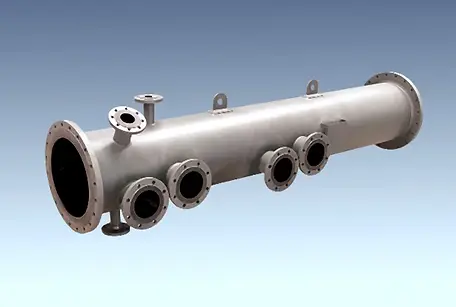
Fluoropolymer coating for industrial chemical protection
Parameters to know before choosing a coating
Effective chemical protection is not chosen solely by product name: it is tailored to your actual conditions.
Nature of the fluid
Acid, base, solvent, contaminated water, chemical mixture or effluent: each fluid requires specific compatibility.
Concentration
The same product can be compatible at low concentrations and too aggressive at high concentrations.
Temperature
Temperature often accelerates chemical attack and strongly influences the choice of coating.
Exposure mode
Permanent immersion, projection, condensation, steam or occasional cleaning: the risk is not the same.
Mechanical constraints
Abrasion, shocks, turbulence or handling may necessitate a thicker or more robust system.
Geometry of the room
Angles, welds, flanges, threads or confined areas require appropriate preparation and application.
Do you have a fluid, a concentration, and a temperature?
Send this information along with a plan or photo: we will guide you towards the most suitable technology.
Our solutions for protection against chemical attacks
We choose the protection according to the corrosion mechanism, the criticality of the part, the exposure and the process constraints.
Halar® / ECTFE
Fluoropolymer solution recognized for corrosion protection in harsh chemical environments.
Tanks, reactors, piping
Good chemical resistance
Thicknesses suitable for harsh environments
PTFE / PFA
Fluoropolymer coatings adapted to the needs of low adhesion, chemical resistance and thermal stability.
Process parts and technical components
Specific chemical applications
Selection based on temperature and fluid
Multilayer systems
When there are multiple constraints, a complete system can combine preparation, primer and functional layer.
Reinforced chemical barrier
Optimized adhesion and continuity
Controls adapted to the specifications

Atmospheric corrosion protection – zinc flake / industrial paint

Chemical corrosion protection – fluoropolymer coating (Halar/PTFE/PFA)
Our methodology
Lasting protection depends as much on preparation and controls as on the product itself. We frame, apply, and monitor.
1. Analysis of the environment
Fluid, concentration, temperature, duration of exposure, immersion, splashes or vapors.
2. Choice of coating
Halar®, PTFE, PFA or other system depending on chemical compatibility and mechanical constraints.
3. Surface preparation
Sandblasting / preparation adapted to the substrate to guarantee adhesion and hold.
4. Application & Controls
Controlled application + thickness control/inspection. Traceability as needed.

In our workshops: resources, processes, rigor and control.
Large rooms?
We handle parts up to 12m (depending on geometry). Send us your plan and photos, and we'll review your case.
FAQ – Frequently Asked Questions
Frequently asked questions for choosing a coating in an aggressive chemical environment.
Request a technical study / a quote
Describe your chemical environment and your room: we offer you a suitable protection solution (coating, thickness, preparation), with a technical and sustainability-oriented approach.
Contact : online form
Need a quick opinion?
Simply send us: class (if known) + 2 photos + dimensions. We will then provide you with technical guidance.
Resistance to chemical attacks
Our fluoropolymer coatings (PTFE, PFA, ETFE) are designed to provide durable protection against the most aggressive chemical environments, including under severe temperature and concentration conditions.
Compatibility table for some chemicals
Chemical product Concentration Indicative temperature Resistance
Sulfuric acid (H₂SO₄) up to 98% up to 60–80°C ✔️ Excellent
Concentrated hydrochloric acid (HCl) up to 80°C ✔️ Excellent
Concentrated nitric acid (HNO₃) up to 60°C ✔️ Very good
Sodium hydroxide (NaOH) up to 50% up to 80°C ✔️ Excellent
Concentrated ambient to high ammonia ✔️ Excellent
Pure room temperature acetone ✔️ Excellent
Pure room temperature toluene/xylene ✔️ Excellent
Ambient methanol/pure ethanol ✔️ Excellent
Hydrocarbons (diesel, fuel oil) - ambient to high ✔️ Excellent
Ambient saturated saline solutions ✔️ Excellent
Dry/wet chlorine depending on conditions ✔️ Very good
Oxidizing acids vary depending on conditions ✔️ Good to excellent
Broad spectrum of protection
Our solutions provide high resistance against:
Acids:
Sulfuric acid, hydrochloric acid, nitric acid, phosphoric acid, organic acid…
Basics:
Caustic soda, potash, ammonia…
Solvents:
Ketones, aromatics, alcohols, hydrocarbons…
Industrial products:
Fuels, oils, petrochemicals, salts, chemical solutions…
Typical applications
Chemical tanks and reservoirs
Surface treatment equipment
Pipe networks
Mechanical parts exposed to corrosive agents
Petrochemical and pharmaceutical environments
⚠️ Technical validation
Chemical resistance depends on the actual conditions of use: concentration, temperature, pressure and duration of exposure.
A compatibility study is carried out on request to validate your application.